

If “stdio” is a Vulnerability, So Is “git clone” – Notes on Riding the AI Vulnerability Trend
A developer clones a repository and opens it in VS Code at 10:47 a.m. Before...

 Blog
Blog

Jan 14, 2026

The ARMO-Rapid7 partnership connects broad attack surface coverage with deep cloud and Kubernetes runtime security and visibility. By correlating exposures with real workload behavior, organizations can identify meaningful risk earlier, focus remediation where it matters most, and respond to active threats with precision, improving security outcomes while operating more efficiently in cloud-native environments.
Most security leaders already have strong visibility into their environments. They know what assets exist, which workloads are exposed, and where misconfigurations or vulnerabilities might exist.
Yet breaches continue to happen. Not because teams lack findings, but because risk in the cloud is conditional and time-bound.
As cloud environments grow more dynamic, static findings alone can’t explain real risk. A vulnerability or misconfiguration only matters when it’s reachable in real time, exercised, and combined with suspicious behavior.
Static exposure data captures possibility. Runtime behavior reveals reality.
Philip Bues, senior research manager, IDC Security and Trust, summed it up clearly:
“As enterprises face increasingly fragmented and complex cloud threats, the need for full visibility across all cloud environments continues to be paramount. Rapid7’s partnership with ARMO helps to meet that market need by connecting the dots between proactive exposure management and real-time threat detection & response.”
Exposure management excels at mapping the attack surface and identifying weaknesses across complex environments. But on its own, it cannot answer several critical questions:
Without runtime context, teams are forced to prioritize based on severity scores, assumptions, or best guesses. That often leads to over-remediation in some areas and blind spots in others.
This is not a tooling failure—it’s a structural limitation of static analysis in dynamic systems.
The ARMO–Rapid7 partnership is designed to close this gap.
Rapid7 provides broad coverage across external exposure, cloud misconfigurations, vulnerabilities, and identity risk. ARMO adds cloud and Kubernetes runtime visibility, observing how workloads and applications behave in production.
Together, they allow teams to correlate exposure with behavior.
Instead of treating every finding as equally urgent, organizations can see:
This correlation turns exposure management into a system for identifying active and emerging risk, not just documenting weaknesses.
Cloud-native environments like Kubernetes are dynamic by design. Workloads are temporary. Deployments change frequently. Permissions span cloud, cluster, and application layers.
Attackers take advantage of this complexity.
As a result, modern cloud attacks rarely follow a single exploit path. Instead, they unfold as a sequence of small actions:
Without runtime insight, these signals appear disconnected or are missed entirely.
Viewed together at runtime, they form a clear attack pattern.
ARMO’s runtime approach is Kubernetes-native. It establishes a baseline of expected behavior and detects deviations that indicate real threat activity, not just policy violations.
Consider a Kubernetes workload that is internet-facing and uses a cloud IAM role with broad permissions.
From an exposure standpoint, this is already flagged as risky. But without runtime insight, it remains one of many similar findings competing for attention.
When runtime visibility is added:
Now the risk is no longer theoretical.
Security teams can clearly see:
This is how ARMO’s CADR (Cloud Applications Detection & Response) shortens the path from detection to decision.
One of the most important benefits of correlating exposure with runtime is earlier risk reduction.
With ARMO CADR integrated into Rapid7:
This improves security outcomes while reducing wasted effort, an increasingly important balance in cloud-native operations.
Runtime security is often viewed as operationally heavy. In practice, inefficiency comes from poor signal quality and fragmented workflows, not from runtime insight itself.
ARMO’s approach emphasizes Kubernetes-native context and behavior-based detection, producing signals that are clearer and more actionable.
Integrated into Rapid7’s platform, investigation and response can happen in one place, without stitching together tools or exporting data across teams.
That efficiency matters as environments scale and responsibilities remain shared across security, platform, and engineering teams.
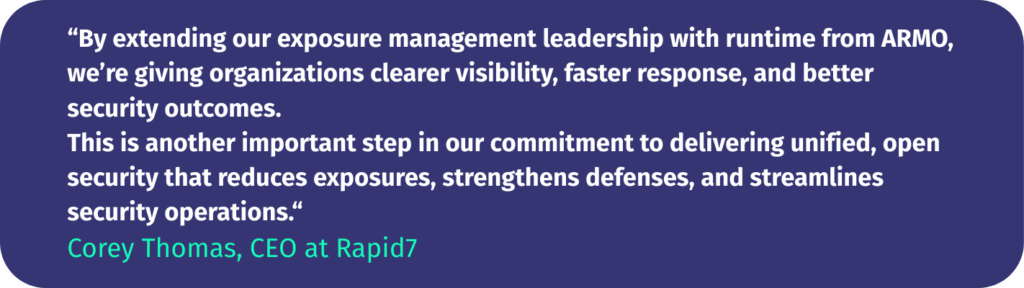
Resilience is not about preventing all risk. It’s about detecting meaningful threats early, understanding why controls failed, and responding in a way that limits impact.
By connecting runtime activity to exposure data, organizations gain earlier detection of real attacks, clearer insight into root cause, and a feedback loop that strengthens defenses over time.
This is how security programs evolve from reactive to resilient.
Cloud risk is dynamic. Security programs that rely solely on static views of exposure will always be one step behind.
By combining broad attack surface visibility with cloud and Kubernetes runtime insight, the ARMO–Rapid7 partnership enables organizations to reduce risk earlier, operate more efficiently, and build security programs that keep pace with how modern environments actually behave.

A developer clones a repository and opens it in VS Code at 10:47 a.m. Before...
Your engineering lead is in your office Thursday morning. They want to push an AI...
A platform security engineer gets an alert at 2:14 a.m. One of the LangChain agents...






 Continue as a guest