Get the latest, first
arrowBlog
ARMO vs Wiz: Why Runtime-Native Beats Agentless-First for Kubernetes Security

ARMO vs Wiz: Why Runtime-Native Beats Agentless-First for Kubernetes Security

Apr 29, 2025


Key takeaways

  • Is ARMO or Wiz better for Kubernetes security? For teams whose center of gravity is a Kubernetes cluster, ARMO is the stronger choice. ARMO observes every workload's runtime behavior by default and converts what it sees into enforcement, while Wiz applies its eBPF sensor selectively on top of an agentless posture core. Wiz wins on breadth across clouds and compliance frameworks; ARMO wins on the dimensions that decide runtime security inside the cluster.
  • What actually separates runtime-native from agentless-first? The order the platform was built in, which determines what it can do with behavior. Wiz added a runtime sensor to a posture-first product, so observed behavior feeds detection and alerts. ARMO was built on runtime from the start, so observed behavior also generates NetworkPolicies, seccomp profiles, and per-workload enforcement - prevention, not just detection.

An attacker lands in a workload your security tool classified as low priority. What happens next depends entirely on one architectural choice: whether runtime observation is something your platform does everywhere by default, or something you switched on for the workloads you remembered to flag. Wiz and ARMO sit on opposite sides of that choice.

Wiz built agentless posture first and added an eBPF runtime sensor on top, deployed where you decide deeper visibility is worth it. ARMO built on runtime from the start: every workload is observed by default, and that observed behavior is the raw material for detection, vulnerability prioritization, and generated enforcement. For a Kubernetes-centric team, this comparison comes down to which of those two architectures you want underneath you, and the six dimensions below show why ARMO takes the cluster.

Wiz Added Runtime. It Didn’t Become Runtime-Native.

Wiz built its business on agentless scanning, reading cloud and Kubernetes APIs without anything running inside the workload. Wiz Defend adds an eBPF sensor on top of that foundation, and Wiz’s own materials describe the model plainly: start with agentless coverage, then add the sensor to the workloads where deeper visibility is worth it. 

But the foundation is still agentless. Runtime is an addition to a posture-first product, not the ground it was built on. ARMO is the inverse. It is runtime-native: an eBPF sensor observes every workload’s behavior by default, and that behavior is the raw material the rest of the platform is built from.

That ordering is the whole comparison. When posture is the foundation, runtime is one more input feeding detection. When runtime is the foundation, observed behavior feeds posture, vulnerability prioritization, and the policies that prevent the next attack. A sensor bolted onto an agentless core can watch and alert. A platform built on behavior can watch, alert, and then write the enforcement from what it saw. Almost every difference below comes back to which of those two things you are buying.

Score Them on Six Dimensions: ARMO Takes the Cluster, Wiz Takes the Breadth

Security leaders do not choose tools on feature counts. They choose on a handful of decision dimensions, and the same six show up across most evaluations. Here is how the two products land on each one for a Kubernetes-centric buyer.

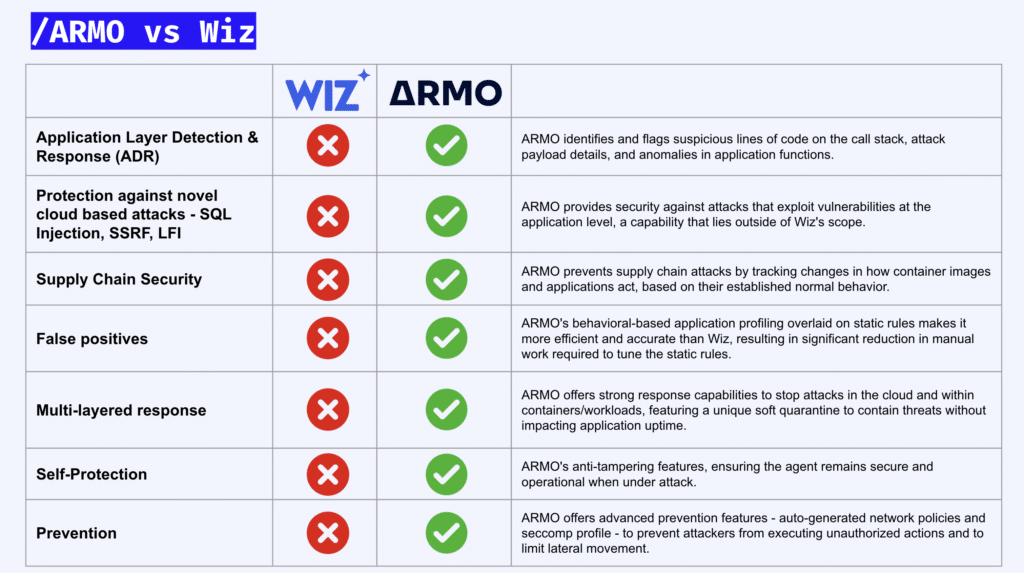
Decision dimensionARMOWizEdge
1. Problem and solution fitRuntime-native and Kubernetes-deep, with 250+ Kubernetes-native controlsAgentless-first and broad across clouds; runtime via an optional sensor on selected workloadsARMO
2. Integration and architecture fitRuntime-native eBPF, no sidecars, 1 to 2.5% CPU; converts observed behavior into NetworkPolicies and seccomp profilesAgentless core plus an eBPF sensor; behavioral baselining for detection, without behavior-derived policy generationARMO
3. Risk and compliance coverage250+ Kubernetes-specific controls, with risk prioritized by runtime data250+ frameworks and broad multi-cloud complianceARMO on Kubernetes depth; Wiz on framework breadth
4. Vendor trust and stabilityOpen-source Kubescape core, CNCF-governed, with a publicly auditable roadmapPart of Google Cloud, with the scale that brings; proprietary platformARMO on transparency; Wiz on financial scale
5. Total cost of ownershipSelf-service Startup plan (up to 25 worker nodes, limited features, community support), a two-week free trial, and no sales process to startQuote-based enterprise pricingARMO
6. Team adoption and operabilityOne attack story across all four layers, with remediation that will not break the workloadPosture-led security graph, with runtime detection through the sensorARMO

The pattern is consistent. ARMO takes the dimensions that decide runtime security inside the cluster. Wiz takes breadth across clouds and frameworks. The rest of this comparison works through why, and is honest about the two places Wiz genuinely wins.

Does Agentless-First Leave Blind Spots in Your Cluster?

Wiz’s own recommendation is to put the sensor where kernel-level visibility is worth the effort, which in practice means the workloads someone has already flagged as critical. Everything else runs on agentless posture alone: the non-critical services, the short-lived jobs, the workload that spun up an hour ago and has not been triaged yet. Posture reads the cluster’s configuration and the cloud APIs. It does not watch what those workloads actually do.

That is the blind spot. On any workload without the sensor, the syscalls a container makes, the process that spawned another process, the pod reaching out to a destination it has never contacted before, none of it is observed until someone decides that workload was important enough to instrument. Attackers do not wait for that decision. The initial foothold is usually the workload nobody was watching closely, which is exactly the workload agentless coverage sees as a configuration rather than as behavior.

ARMO removes the triage step. Runtime-native means the sensor is on every workload by default, so behavior is observed everywhere from the start, not after a workload earns attention. Wiz covers more clouds and more services across a multi-cloud estate, and for that breadth it is a capable tool. Inside the Kubernetes cluster, where the question is whether you are watching behavior or only configuration, default-everywhere beats sensor-where-you-remembered-to-put-it.

Can the Tool Turn Observed Behavior Into Prevention, Not Just Detection?

Detection tells you something went wrong. Prevention stops it from going wrong again. The line between the two is whether a tool can take what it observed and turn it into enforcement, and this is where the architectural split stops being abstract.

ARMO watches each workload long enough to learn its normal behavior, a per-workload behavioral baseline it calls Application Profile DNA, then generates the controls that lock that behavior in. It produces Kubernetes NetworkPolicies from the traffic it actually saw, so the policy reflects the connections the workload really makes instead of a guess. It generates seccomp profiles the same way, from the syscalls the container actually used, and delivers them as Kubernetes resources you can apply. ARMO’s approach to generating seccomp profiles from observed behavior runs on its eBPF sensor, and it follows an observe-to-enforce sequence: watch the workload, baseline what is normal, generate the policy, run it in audit mode to catch false positives, then enforce.

This is the buyer question that separates the two products. Can it write my NetworkPolicies from how traffic actually flows, or do I still hand-author every one? Hand-written network policies are the work that stalls microsegmentation for months, because writing a correct policy means knowing every legitimate connection a service makes before you can deny the rest. ARMO generates that policy from observed traffic. Wiz baselines behavior for detection, and its own academy points teams to dedicated engines like Calico for network policy; generating policies from behavior is not a capability Wiz claims. The same gap applies to seccomp.

The same behavioral foundation extends beyond traditional workloads. AI agents are non-deterministic by design, which makes static rules a poor fit, and the most useful control is one derived from how an agent actually behaves. ARMO’s security for AI agent workloads on Kubernetes detects deviations from an agent’s learned behavior and progressively enforces on what the agent does at runtime, which is the kind of control posture scanning cannot produce. And it does all of this at a runtime cost of 1 to 2.5% CPU and around 1% memory, with no sidecars to inject.

Whose Foundation Are You Actually Standing On?

ARMO is built on Kubescape, an open-source project it created and donated to the Cloud Native Computing Foundation, where it is an incubating project used by more than 50,000 organizations and one of the most widely adopted open-source Kubernetes security tools. That foundation is public, forkable, and auditable, which means you can read exactly what your security platform does rather than trust a description of it.

The strongest evidence for that foundation comes from Wiz itself. Wiz’s own academy recommends Kubescape by name as a tool for benchmarking clusters against CIS and NSA frameworks, and credits ARMO as its creator. When a competitor’s own educational content sends teams to the project you build, the open-source question is largely settled.

The entry path is different too. ARMO offers a self-service Startup plan that covers up to 25 worker nodes, with a limited feature set and community support, and a two-week free trial to prove value on your own cluster before any budget conversation. Wiz is sold through quote-based enterprise pricing. For a team that wants to see the platform working on its own workloads before committing spend, one path starts today and the other starts with a sales call.

There is a fair counterpoint on stability. Wiz is now part of Google Cloud, which gives it scale and funding ARMO does not match, and for some buyers that backing matters. What it does not give is transparency. A roadmap and a security posture you can inspect, on a foundation governed by a neutral body rather than a single vendor, is a different kind of trust, and it does not depend on who owns the company this year.

Will You See the Whole Attack, or Five Alerts in Five Consoles?

When an attack crosses layers, most tools show you fragments. The cloud tool flags a new role. The container tool flags a suspicious process. The network tool flags an odd connection. Three alerts, three consoles, and a person trying to reconstruct whether they are one incident or three. That reconstruction is why investigations take days.

ARMO correlates the layers into a single attack story, the core of its Cloud Application Detection and Response approach. It links cloud events, Kubernetes API activity, container behavior, and application-layer activity into one causal chain, with a timeline, the entities involved, the blast radius, and the application call stack that shows what actually executed. That application-layer visibility reaches into encrypted traffic as well: ARMO inspects TLS/SSL application traffic through eBPF uprobes, full L7 visibility with no sidecar and no proxy. ARMO puts the reduction in investigation and triage time at more than 90%, because the chain is assembled for the analyst instead of by them. And because the story is grounded in observed behavior, the remediation it suggests is a policy change tied to what the workload really does, a fix that tightens security without breaking the workload.

Here the buyer question gets specific. When it shows me the incident, does the story include the application call stack, or just process and cloud events on a graph? The call stack is what tells you which code path the attacker actually reached, not only that a pod behaved oddly. ARMO’s story carries the call stack and the relevant API calls. Wiz reconstructs the attack path from process trees, forensic artifacts, and cloud telemetry, which is a real capability that keeps improving, but the application call stack is not part of it. Wiz’s security graph is genuinely strong for mapping exposure across a cloud estate. As a record of how a single incident unfolded inside the cluster, a posture-led graph is a different thing from a runtime causal chain.

Both products prioritize vulnerabilities by runtime reachability, so that is not a deciding factor between them. The deciding factor is whether the incident arrives as one story or as five alerts you have to assemble yourself.

Where Wiz’s Breadth Wins, and Why ARMO Still Belongs in Your Cluster

Wiz covers more clouds and more compliance frameworks than ARMO, and saying so plainly is what makes the rest of this credible. If broad agentless posture across AWS, Azure, and Google Cloud is the primary problem, Wiz is built for exactly that. The right move there is not to replace it. It is to run ARMO alongside it for Kubernetes runtime, where posture coverage alone leaves the behavioral gap this comparison has worked through.

Framework breadth is a similar story. Wiz maps to a long list of frameworks; ARMO goes deep on 250+ Kubernetes-specific controls. For a team reporting on a broad multi-cloud compliance program, breadth matters. For a team hardening Kubernetes, depth on the controls that apply to Kubernetes matters more.

Admission control and cloud identity look like Wiz territory on paper; neither is. ARMO blocks non-compliant workloads at deploy time through native Kubernetes Validating Admission Policies, and is the creator of the open-source CEL Admission Library, a Kubescape project – so deploy-time validation and behavior-derived runtime enforcement come from the same platform, on the same open foundation. 

On cloud identity, ARMO delivers CIEM in the Kubernetes scope today – RBAC, blast-radius mapping, and Kubernetes-Service-Account-to-cloud-identity correlation, KSA to GCP Workload Identity for example – with full cloud-IAM CIEM on the roadmap. Wiz’s IAM graph still reaches wider across a multi-cloud estate; inside the cluster, the identity picture ARMO draws is grounded in the workloads it watches.

Image security splits by stage rather than by winner. Wiz scans image layers for known-malicious packages before deployment. ARMO validates image signatures to enforce provenance before workloads run, then detects and quarantines malware at runtime, the point where a payload that slipped past a static scan executes.

None of this is a reason to pick Wiz for runtime. It is a clear-eyed map of where each tool’s design points, so the two can be deployed for what each does best.

For Kubernetes Runtime, the Behavior-Derived Layer Decides It

Run the six dimensions back through one lens and the picture is consistent. On problem fit, ARMO goes deep where the Kubernetes cluster lives. On architecture, it converts behavior into prevention instead of only detection. On Kubernetes risk and compliance, its controls are built for the platform you actually run. On foundation, it stands on an open project anyone can audit; on cost of entry, a self-service plan and a two-week trial replace the quote cycle. On the attack story, it hands you one causal chain instead of five alerts. Wiz wins breadth across clouds and frameworks, and that is worth having where breadth is the job.

The deciding factor is not whether Wiz can see runtime. It can. It is that Wiz added runtime to a posture-first product, while ARMO was built on runtime from the start, and only a platform built on behavior can take what it observes and write the enforcement from it. For Kubernetes runtime security, that behavior-derived layer is the difference that decides it.

The fastest way to test this is on your own cluster. Validate detection yourself: ARMO’s Cloud Threat Readiness Lab (CTRL) injects real attack behaviors into your cluster so you can watch ARMO detect and respond before you commit. Watch a demo of ARMO to see behavior-derived NetworkPolicies, seccomp generation, and full attack-story correlation, then run the two buyer questions above against whatever you are evaluating: can it generate policies from observed traffic, and does its incident story include the application call stack.

Questions Teams Ask When Comparing ARMO and Wiz

How do I add ARMO to a Kubernetes estate Wiz already covers?

Deploy ARMO’s eBPF sensor with its Helm chart and start in observe mode, where it discovers workloads and builds behavioral baselines without sidecars or code changes. Leave Wiz’s posture layer in place; ARMO is adding runtime depth, not replacing configuration scanning. After a baseline window, you move to enforcement on the workloads that need it.

How do I generate NetworkPolicies and seccomp profiles from my running workloads?

Run ARMO in observe mode for two to four weeks so it captures each workload’s real network destinations and the syscalls its containers actually use. Then generate the NetworkPolicy and seccomp profile from that observed behavior, and deploy them in audit mode first so you can catch any legitimate traffic the baseline missed before you enforce. This is the step that replaces hand-authoring policies from documentation that is usually out of date.

How do I validate runtime depth during an ARMO and Wiz proof of concept?

Run a read-only proof of concept on your own cluster and ask each tool to reconstruct a full attack that crosses cloud, Kubernetes, container, and application layers, including the application call stack. A tool that can only show process events, network flows, or posture findings cannot produce the execution-path evidence an investigation needs. Ask the same vendors how they generate enforcement from observed behavior, and watch which one shows you a generated policy. ARMO’s Cloud Threat Readiness Lab (CTRL) is built for exactly this step: it injects real attack behaviors into your cluster so you can watch detection and response live during the evaluation.

How do I secure AI agent workloads on Kubernetes that posture scanning misses?

Treat each agent as a non-deterministic workload: baseline how it behaves, detect deviations from that baseline, and progressively enforce per-agent controls on what the agent does at runtime. Posture scanning can check an agent’s configuration but cannot see its behavior, which is where the risk lives once an agent starts making its own decisions. ARMO’s behavioral approach covers detection and enforcement at the runtime layer that configuration checks cannot reach. ARMO also breaks down how to evaluate AI workload security across discovery, posture, and runtime detection for teams scoping their own coverage.

Can ARMO see inside encrypted traffic?

Yes. ARMO inspects TLS/SSL application traffic through eBPF uprobes, which gives full L7 visibility with no sidecar and no proxy to deploy. That means application-layer detections and the attack-story call stack keep working even when traffic is encrypted, which in a production cluster is most of it.

What automated response actions can ARMO take?

ARMO can kill a malicious process, stop or pause a container, and apply network-level isolation, scoped by environment with guardrails so response in production behaves differently from staging. Because each action is tied to the attack story, the response targets the workload behavior that triggered it rather than a broad quarantine.

Close

Your Cloud Security Advantage Starts Here

Webinars
Data Sheets
Surveys and more
Group 1410190284
Ben Hirschberg CTO & Co-Founder
Rotem_sec_exp_200
Rotem Refael VP R&D
Group 1410191140
Amit Schendel Security researcher
slack_logos Continue to Slack

Get the information you need directly from our experts!

new-messageContinue as a guest