

Best Cloud Application Security Tools: 10 Solutions for 2026
Key Insights What is cloud application security? Cloud application security is the set of practices,...

 Blog
Blog

Nov 6, 2025

Within 24 hours, three new high-severity vulnerabilities were disclosed in runc, the low-level runtime that underpins most container platforms, including Docker, Containerd, Kubernetes, and nearly every major cloud provider’s managed Kubernetes service. These vulnerabilities (CVE-2025-31133, CVE-2025-52565, CVE-2025-52881) allow a malicious container image to break out of the container boundary and affect the host machine directly.
While the attacks require a specially crafted container image and, in some cases, elevated privileges inside the container, the impact is serious: host compromise or denial of service. This disclosure reinforces a recurring truth in cloud security: the container boundary is not a security boundary by itself. Strong supply-chain controls and runtime detection are critical.
Most container users have never interacted with runc directly, but it is everywhere.
runc is the reference implementation of the Open Container Initiative (OCI) runtime specification. It is the component responsible for creating containerized processes: configuring kernel namespaces, cgroups, mounts, and process isolation. This enables the creation of containers on Linux machines.
If you run:
… on Linux hosts, you are using runc under the hood.
When a vulnerability affects runc, it affects the foundation of nearly all containerized workloads.
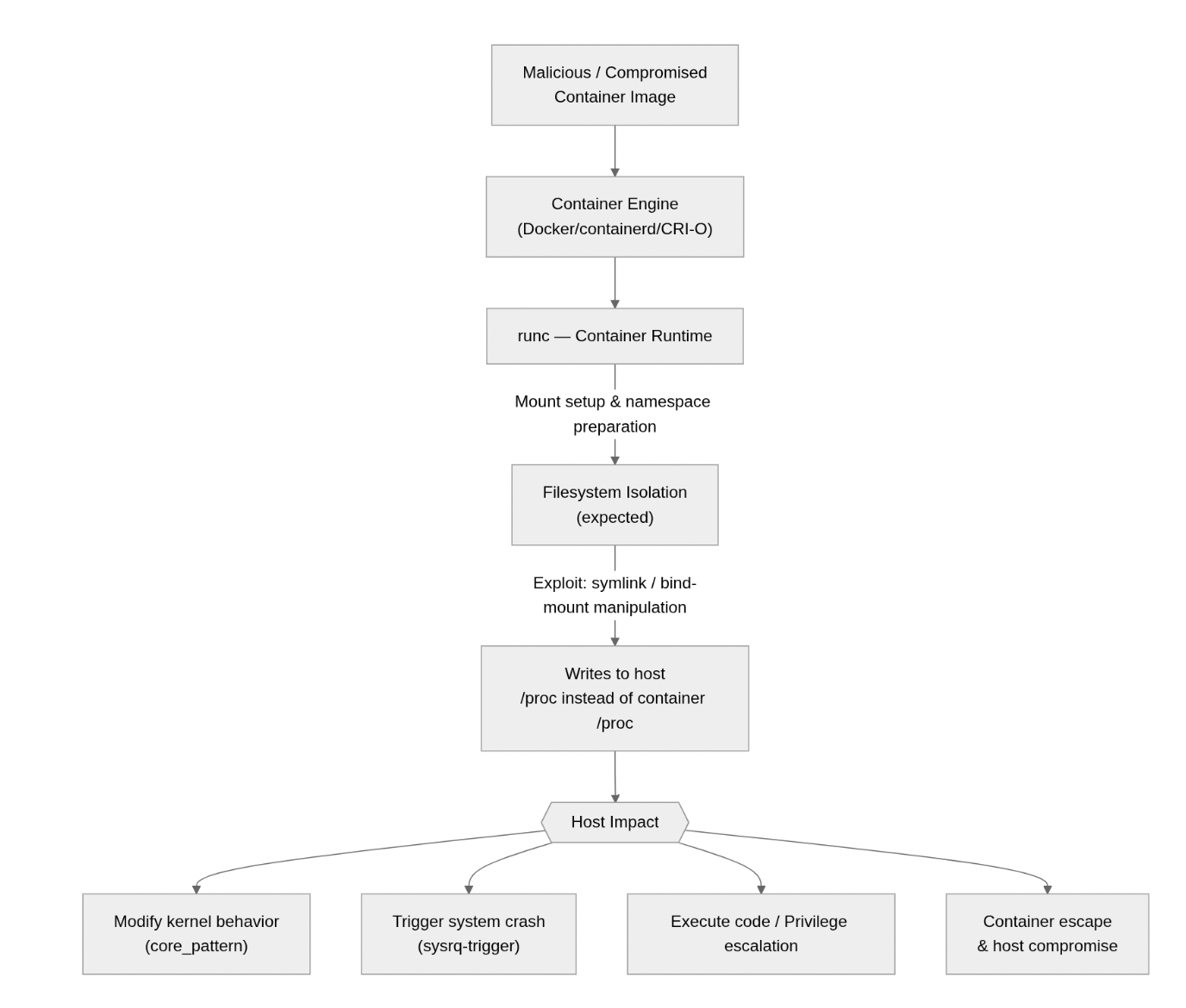
The attack begins with a malicious container image, either:
The attacker does not need to exploit a kernel bug. Instead, they exploit how runc handles mounts and special files during container startup. By combining symlinks, bind mounts, and some timing tricks, the attacker convinces runc to write to the host’s /proc filesystem instead of the container’s view of it.
This is where the real danger begins.
/proc is a virtual filesystem used by Linux to expose and control kernel behavior. Containers should see their own “copy” of /proc, separate from the host. If a malicious container can write to specific /proc files of the host, it can:
| Host Target | Result |
|---|---|
| /proc/sys/kernel/core_pattern | Run arbitrary commands on the host whenever any process crashes |
| /proc/sysrq-trigger | Force a system reboot or crash immediate denial of service |
| /proc/sys/* settings | Modify kernel-level system behavior, potentially weakening security |
In practical terms, the attacker could:
This is a container escape, achieved without touching the kernel or hypervisor. The attacker is simply abusing runc’s trust that the container filesystem is isolated which, under these conditions, it is not.
Update runc to a patched version:
Restart container engines after updating:
systemctl restart docker
# or
systemctl restart containerd
| Provider | Status / Action |
|---|---|
| AWS EKS | Check AWS Security Bulletin |
| Azure AKS | Node base images will be patched; users must reimage or rotate nodes. See security bulletins. |
| Google GKE | Look for security release channels and perform node pool upgrades. |
In all managed Kubernetes cases:
Upgrading the control-plane alone is not enough — worker nodes must be refreshed.
This event highlights a long-standing security reality:
If a container is running untrusted code, assume it can escape under the right conditions.
To reduce exposure:
Use:
Even with patches and signing, supply-chain compromise is always possible. A zero-day in a base image, a compromised build step, or a malicious dependency can bypass traditional controls.
A runtime security platform like ARMO detects:
These are exactly the signals triggered in the runc exploit chain.
Tie behaviors to workloads, not IPs or nodes.
The new runc vulnerabilities are not just another set of CVEs—they are a reminder that containerization does not equal security. The isolation boundary is thin, and attackers are creative.
To stay secure:
With ARMO, organizations gain continuous detection and response for container and cloud-native environments allowing them to identify supply-chain attacks, privilege escalation attempts, and container escapes in real time.

Key Insights What is cloud application security? Cloud application security is the set of practices,...

Key Insights Why do existing application detection tools fail in Kubernetes environments? A: Most were...

Key Insights Introduction You’re not struggling to find cloud security tools. You’re struggling to compare...








 Continue as a guest