

Runtime Incident Classification: Turning a Noisy Alert List Into a Triage Decision
Here is a scene every security team knows. A reverse shell opens a connection to...

 Blog
Blog

Dec 8, 2025
In this article, we’ll break down the three most prevalent runtime threat vectors behind most modern cloud breaches – and why traditional cloud security tools fail to detect them.
Let’s get one thing clear: the cloud itself hasn’t become more dangerous – but cloud-native architectures fundamentally changed the threat landscape.
In the datacenter era, most threats targeted hosts, networks, and endpoints. In short, attackers were targeting the infrastructure layer as well as the application. Since cloud vendors are doing a reliable job in security in the infrastructure layer, in the cloud era, attackers go after something far more fluid they’re left with:
These cloud-native characteristics introduce dynamic, high-velocity risk surfaces that traditional tools cannot continuously monitor.
And yet, most organizations are still trying to protect cloud environments with ineffective solutions or tools designed for a completely different world.
If you want to understand modern cloud risk, you don’t need a 200-page CNAPP whitepaper. you need to understand three core runtime cloud workload threat vectors. Ignore these three, and you’re exposed, no matter how many dashboards you have.
Let’s break them down.
These attacks target the running application layer, not the infrastructure, making them invisible to most posture-based tools. This is not a theoretical “shift left” conversation. This is the part where things break in production.
Common real-world application-layer attack types include:
Everyone “knows” application security is important. But here’s the uncomfortable truth:
Even mature AppSec teams with robust SAST/SCA/DAST pipelines… still can’t see what’s happening inside the running application.
This is why so many high-impact cloud incidents begin with a simple phrase:
“An attacker made a crafted HTTP request to an API endpoint…”
If you’re not monitoring runtime behavior at the application layer, you’re blind.
Take the famous example of the CapitalOne attack in 2019, which is one of the most notable cloud breaches via an application-layer attack.
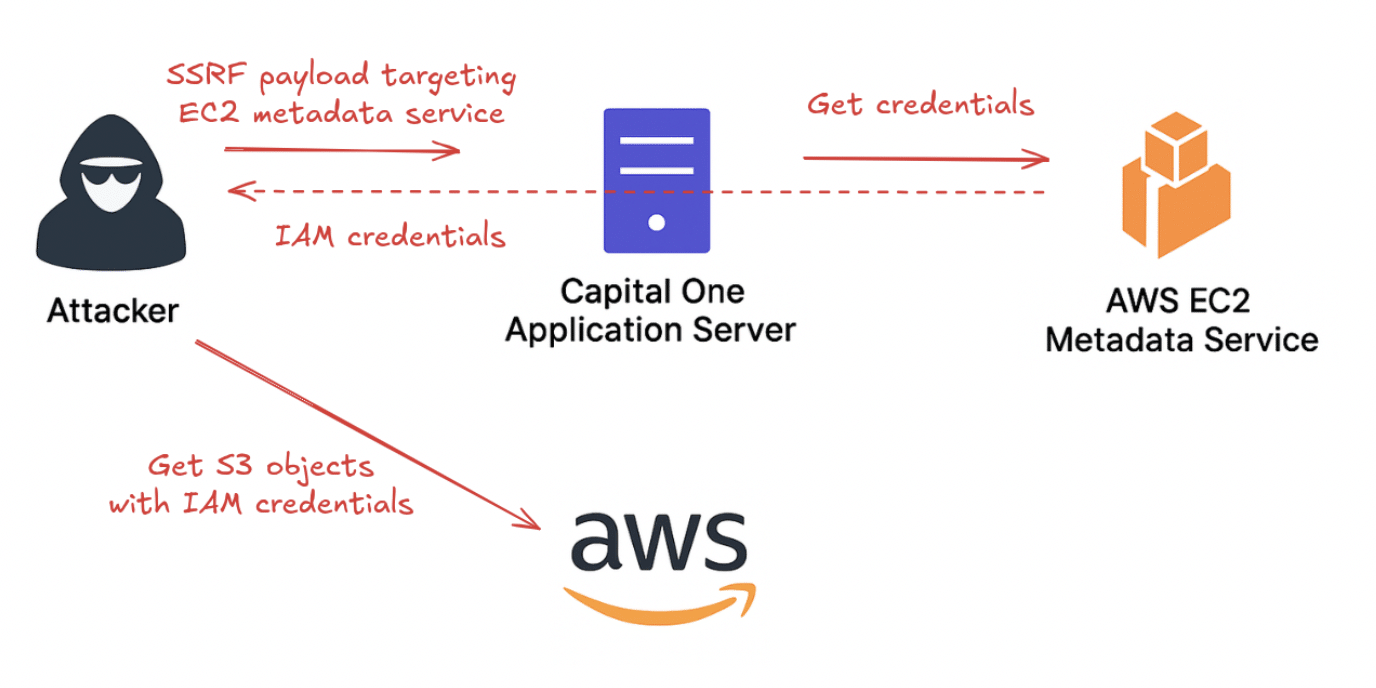
Key Takeaways from this attack:
Let’s be honest: supply chain attacks have become the cheapest zero-days in history.
Attackers no longer need to find a vulnerability in your code. They can:
And here’s the part everyone forgets:
Most supply chain attacks look completely innocent at the deployment time. The code compiles. The pipeline passes. Your SCA scanner sees “no known vulnerabilities.” Everything is green.
Because attackers intentionally insert malicious logic, no CVE will ever exist for the compromised version — making SCA tools effectively blind.
So most software supply chain security tools completely miss these attacks.
The only place to reliably catch supply chain attacks is in runtime. When the application starts doing something it has never done before (new processes starting, new external network connections are initiated, for example)
Runtime version profiling is the missing piece here. If version 1.3 used to make 5 external calls and version 1.4 suddenly makes 43 to untrusted destinations… you don’t need a CVE to understand something’s wrong.
The summer of 2025 saw a surge of software supply chain attacks targeting Node.js packages. In one case, the maintainer of the popular Prettier plugin eslint-config-prettier fell victim to a phishing email, allowing attackers to hijack his npm account. The attackers published new versions of the package (and a few related packages) containing malicious code, specifically, an install.js script that dropped a hidden node-gyp.dll Trojan on Windows systems. This malware (“Scavenger” malware) could harvest files and credentials. The malicious updates (over 78 million weekly downloads worth of packages) were live on npm for at least a day before being detected when users noticed suspicious post-install behavior. Standard supply-chain security tools (like source repository checks or signature verifications) failed to catch the intrusion in time, since the packages were trojanized at the source. Detection relied on user reports and security researchers’ quick action once unusual activity.
Key Takeaway is that supply-chain attacks involve malicious code running within trusted processes. Runtime defenses should watch for abnormal behaviors in package installation and execution. For example, an npm package installer spawning a DLL or making outbound network calls is a red flag that can be caught by an EDR or container security agent
This is exactly why runtime behavioral analysis is required — malicious logic reveals itself only when the package executes.
Let’s talk about the elephant in every cloud breach report: identity.
Cloud environments run on identities:
When an attacker steals a token, they inherit your workload’s exact permissions — no exploit required
And unless you have cloud identity threat detection, here’s what happens:
Identity compromise is the most frequent cause of cloud-native breaches for one reason: it’s the easiest way in, and the hardest thing to detect without runtime context.
You can’t fix this with posture. You can only fix it with detection that understands behavior over time.
An example of the credential misuse or leak attacks (beyond the CapitalOne) is “EleKtra-Leak”.
In another incident in 2025, a former maintainer of RubyGems.org who still possessed unrotated AWS root credentials was able to log in and take control of the organization’s AWS account, modifying IAM roles and attempting to lock out legitimate users (an insider threat scenario).
In both scenarios, the core issue was credentials falling into the wrong hands , whether via external leak or internal oversight, and being used to perform unauthorized actions in the cloud. The initial leak often goes unnoticed; the malicious usage is what eventually raises suspicion (e.g. a sudden spike in AWS costs, strange console logins, or service abuse notices).
Leaked credential misuse often has a distinct fingerprint. Environments should leverage AWS CloudTrail, GuardDuty, and similar services to detect anomalies like an access key being used from an unusual geo-location or a decommissioned account suddenly performing actions. For instance, catching a flurry of EC2 instance creation or high-volume SES email sending from an account that normally doesn’t do that can tip off a compromise in progress.
These three vectors have one thing in common:
They all operate at runtime, the exact layer where most organizations have the least visibility.
And here’s why they consistently slip through the cracks:
Put simply:
Cloud teams are looking at the wrong problems with the wrong tools.
Meanwhile, attackers are exploiting the blind spots that everyone already knows exist.
A modern cloud security program must detect:
And-critically-tie all three together into a single correlated attack story.
Because today’s attacks don’t stay in one lane. They chain:
Exploit → Identity → Lateral Movement → Data
If you don’t have runtime visibility, detection & response across all three vectors, you’re always one step behind.
And this is exactly what ARMO Cloud Application Detection & Response (CADR) is all about.
Cloud risk is broad. Cloud security budgets are not.
If you prioritize everything, you secure nothing.
But if you focus on these three vectors: application behavior, supply chain integrity, and identity misuse, you cover the majority of high-impact, real-world cloud breaches.
Your workloads don’t need another dashboard. They need runtime awareness.
And whether you build it yourself or use a platform like ARMO CADR, one thing is clear:
The future of cloud security belongs to teams who can actually see what’s happening in their workloads and accounts, at runtime.
To summarize –
If you want to see how runtime detection changes your cloud security posture, schedule a demo of ARMO CADR

Here is a scene every security team knows. A reverse shell opens a connection to...
When your CNAPP flags a suspicious dependency in an AI agent container, your WAF logs...

Your behavioral anomaly detection tool just flagged 47 alerts from this morning’s AI agent deployment—but...





 Continue as a guest